

Artificial Intelligence in 2026: Beyond the Hype, Into the Core of the Global Economy
Artificial Intelligence has moved past the experimental phase and firmly into the structural foundation of the global technology ecosystem.

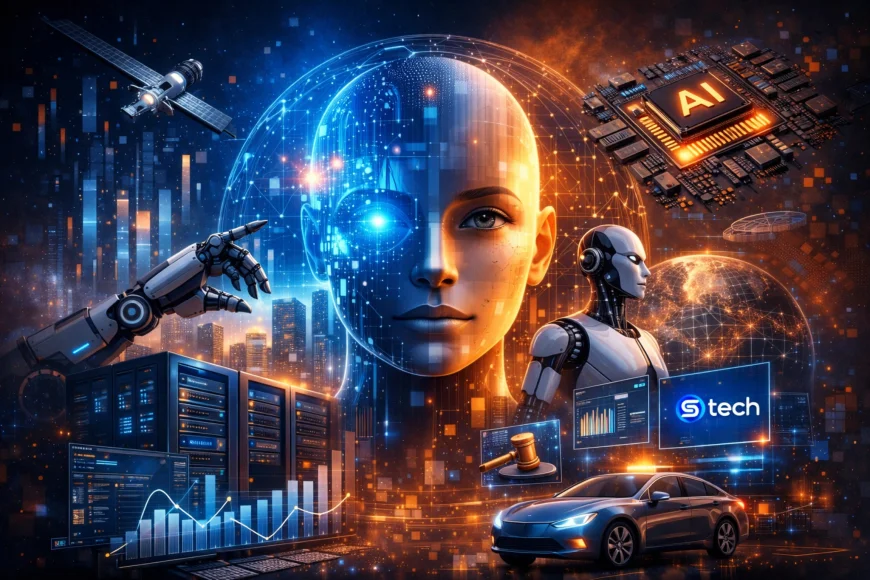
What was once viewed as a breakthrough reserved for research labs and elite universities is now embedded in productivity suites, cloud infrastructure, smartphones, vehicles, and enterprise workflows. In 2026, AI is not a side project—it is the strategic priority.
The explosive visibility of AI began with generative systems capable of producing human-like text and images. Platforms developed by OpenAI demonstrated that large language models could hold context-aware conversations, write code, draft business documents, and assist with research at scale. At the same time, image and video generation tools accelerated creative automation, disrupting industries ranging from digital marketing to game design.
The competitive response from major technology companies was swift and aggressive. Microsoft integrated AI copilots across its productivity stack, embedding generative capabilities directly into enterprise workflows. Google pushed forward with AI-enhanced search and cloud-based foundation models, while Meta Platforms invested heavily in open-weight large language models to shape the ecosystem from a different strategic angle. The result is an AI arms race that spans consumer applications, developer platforms, and infrastructure.
What distinguishes the current phase from earlier AI cycles is practical deployment. Enterprises are no longer asking whether to adopt AI but how quickly they can scale it safely. In financial services, machine learning models are optimizing credit risk analysis, fraud detection, and algorithmic trading strategies. In healthcare, AI-assisted diagnostics are reducing analysis time in radiology and pathology, while predictive systems are helping hospitals manage capacity and patient flow. In manufacturing, intelligent automation is improving quality control through real-time visual inspection systems powered by computer vision.
Cloud infrastructure providers have become the backbone of this transformation. Amazon Web Services, Microsoft Azure, and Google Cloud now offer scalable AI services that allow companies to deploy advanced models without building their own data centers. This democratization of AI infrastructure has dramatically lowered entry barriers, enabling startups to compete in spaces that once required billions in capital expenditure.
Underneath the software layer lies an equally intense hardware battle. AI training and inference depend on high-performance accelerators, and demand for advanced chips has surged worldwide. NVIDIA remains a dominant force in GPU manufacturing, while rivals and hyperscalers invest in custom silicon to optimize cost and performance. The semiconductor supply chain has become strategically critical, influencing geopolitics, trade policy, and national security strategies.
Yet rapid acceleration brings significant challenges. AI governance has emerged as one of the defining regulatory debates of the decade. Policymakers are grappling with issues including algorithmic bias, misinformation amplification, intellectual property disputes, and workforce disruption. The European Union’s AI Act has introduced a risk-based classification system for AI applications, setting a precedent for global regulatory frameworks. In the United States and Asia, similar policy discussions are shaping compliance standards that technology companies must increasingly integrate into product development cycles.
Another pressing issue is energy consumption. Training large-scale foundation models requires immense computational resources, raising sustainability concerns. Data centers optimized for AI workloads demand significant electricity and cooling capacity. As a result, companies are investing in more efficient model architectures, specialized hardware, and renewable energy sourcing to mitigate environmental impact.
Despite fears of job displacement, the labor market impact of AI is more nuanced. Rather than wholesale replacement, most current deployments emphasize augmentation. Software engineers use AI copilots to accelerate debugging and documentation. Legal professionals rely on AI systems to analyze contracts and case law more efficiently. Marketing teams automate content variations while retaining strategic oversight. The productivity gains are measurable, but they require workforce reskilling and digital literacy at scale.
Meanwhile, multimodal AI is shaping the next frontier. Systems that can simultaneously process text, images, audio, and video are unlocking new use cases in education, entertainment, robotics, and autonomous systems. Real-time language translation, AI-driven video synthesis, and personalized digital assistants are rapidly improving in quality and accessibility. The long-term vision of AI as a universal interface—capable of understanding intent and context across mediums—appears increasingly achievable.
Cybersecurity is another domain undergoing structural change. AI systems are now deployed both defensively and offensively. Organizations use anomaly detection models to identify threats faster than traditional methods, while malicious actors experiment with automated phishing and synthetic media. This dynamic has intensified the need for AI-driven security countermeasures, creating a technological escalation on both sides.
Investment trends reflect the strategic weight of the sector. Venture capital funding continues to flow into AI-native startups focusing on vertical solutions—legal tech AI, biotech AI, climate modeling AI—rather than purely horizontal foundation models. Corporations are acquiring smaller AI firms to integrate talent and intellectual property, accelerating consolidation in the market.
Ultimately, Artificial Intelligence in 2026 represents a structural shift comparable to the rise of the internet or mobile computing. It is not a single product category but a horizontal capability reshaping every digital layer. The narrative has evolved from speculative hype to measurable economic impact.
The central question is no longer whether AI will transform industries. It already is. The more complex challenge lies in ensuring transparency, fairness, and sustainability while maintaining innovation velocity. As governments, enterprises, and consumers adapt, AI’s trajectory will be shaped as much by governance and ethics as by engineering breakthroughs.
What's Your Reaction?
 Like
0
Like
0
 Dislike
0
Dislike
0
 Love
0
Love
0
 Funny
0
Funny
0
 Wow
0
Wow
0
 Sad
0
Sad
0
 Angry
0
Angry
0









Comments (0)